
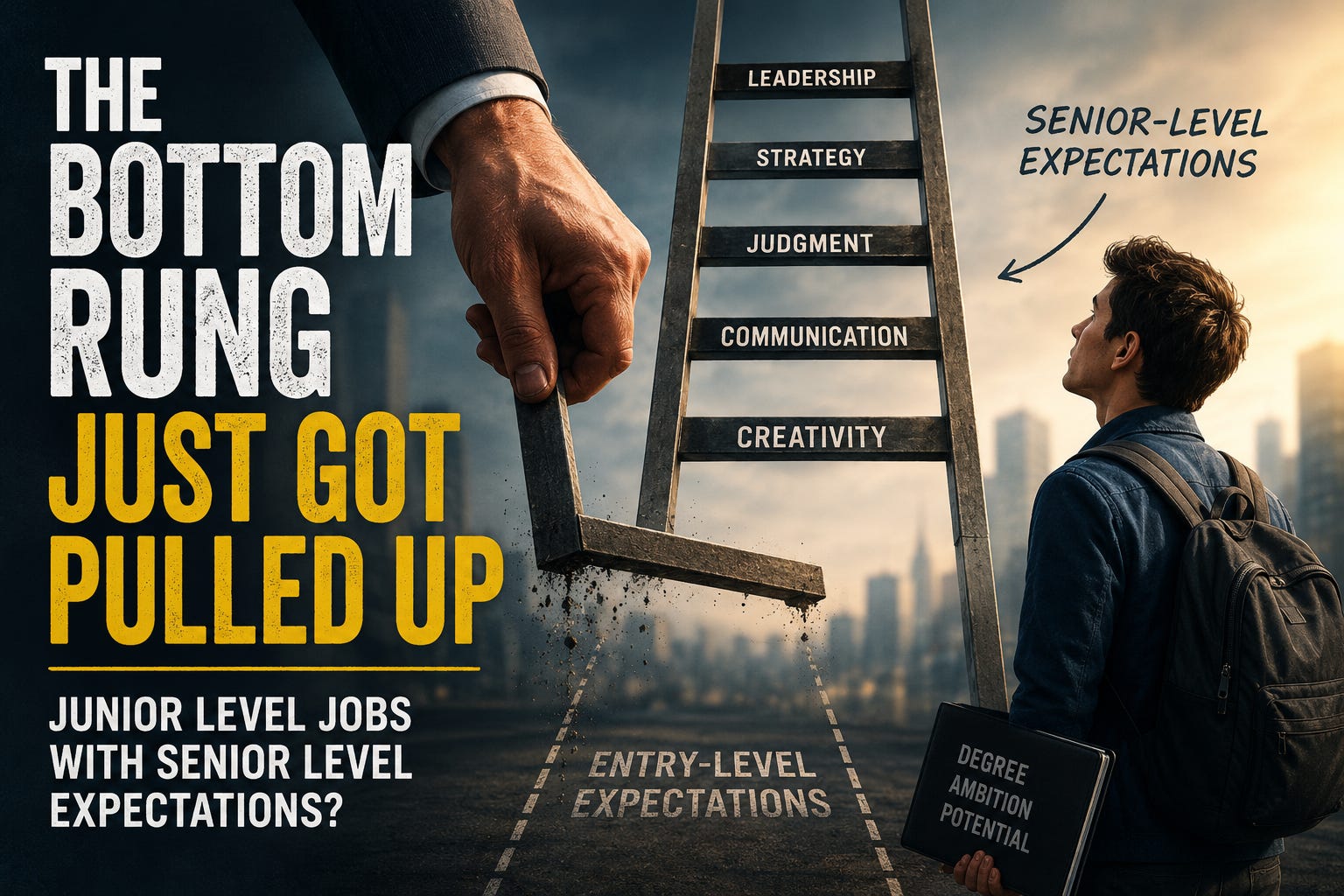
The Bottom Rung Just Got Pulled Up
Junior level jobs with Senior level expectations?

My fellow humans,
This week’s brief should feel uncomfortably close to home for anyone early in their career. For me, two signals stood out above the noise.
• Entry-level white-collar jobs are increasingly demanding senior-level judgment, leadership, creativity, and communication skills.
• The routine work that once trained new graduates is being absorbed by AI, forcing employers to hire for decision-making much earlier than before.
For decades, the path was simple. Get the degree, then land the entry-level job. Once you’re in, you can learn the business by doing the repetitive work nobody else wanted to do. That setup is breaking down fast.
The spreadsheet work, research tasks, meeting summaries, reporting, and first drafts that once served as training wheels are increasingly being handled by machines. Companies aren’t removing the ladder entirely, but they are pulling up the bottom rungs.
The result is a strange new reality where a 22-year-old graduate is often expected to think like a 32-year-old professional.
The workers who thrive in this environment won’t necessarily be the smartest. They’ll be the ones who can combine human judgment with AI leverage, communicate clearly, and prove they can create value before someone gives them permission.
Let’s get into it.
I can almost hear the conversation happening in conference rooms right now.
A hiring manager slides a résumé across the table.
“Great GPA.”
“Strong internship.”
Then someone asks the question that didn’t exist a few years ago.
“Can they actually make decisions?”
That question is becoming the entire game.
PwC’s 2026 AI Jobs Barometer found that AI-exposed entry-level jobs are now seven times more likely to require senior-level skills like leadership, judgment, creativity, stakeholder communication, and face-to-face interaction. Entry-level roles requiring these higher-order capabilities have grown 35% since 2019 while traditional entry-level positions have shrunk by 10%.
The ladder isn’t disappearing, but the bottom rungs are.
For decades, companies hired juniors to do the repetitive work. Build the spreadsheet. Draft the report. Summarize the meeting. Pull the research. The boring work wasn’t exciting, but it taught judgment.
Now the machine does most of that.
A junior analyst who once spent three hours organizing data can finish the same task in fifteen minutes with AI. The company doesn’t need as many people learning through repetition because the repetition is disappearing.
What remains is the work that requires interpretation. The work that requires deciding, explaining and ownership.
That’s why a 22-year-old graduate is increasingly being asked to demonstrate skills that looked like mid-career capabilities only a few years ago.
The mistake is believing this means you simply need to “learn AI.”
That’s like telling someone in 1998 they needed to “learn the internet.”
Too vague, too abstract and too late. The new requirement is AI Command.
Can you take messy information, use AI to accelerate the analysis, identify the tradeoffs, make a recommendation, explain it clearly to another human, and then ship something useful?
That combination is becoming the entry ticket. The degree still matters, it just isn’t enough anymore.
A hiring manager can no longer assume a diploma proves competence because AI has dramatically lowered the cost of producing average work.
What stands out now is proof:
A portfolio, a newsletter, a client project, or a case study.
An internship where you solved a real problem.
A public body of work showing how you think.
The uncomfortable reality is that many graduates are competing against AI-assisted graduates who already have three years of practical output online. That sounds unfair until you realize the tools are available to everyone.
This is why I keep coming back to the same framework:
Hands, Land, Brand, AI Command.
If you’re early in your career, Brand and AI Command deserve immediate attention. Build visible proof of your thinking. Use AI daily until it feels as natural as Google once did. Document projects, analyze industries, and solve problems publicly. Show employers how you think, not just what you studied.
Because the first rung of the white-collar ladder isn’t gone… it’s just higher off the ground than it used to be.
And the people who learn to climb with AI beside them instead of competing against it will reach the next level while everyone else is still wondering why the interview questions suddenly got harder.
If you’re wondering where your profession sits on the risk spectrum, take the free 60-second AI Risk Check right now and see where you actually stand.
The office lights are still on, and the jobs still exist…
But the training wheels are already coming off.
— Anthony
Forward this to the smartest person you know at work. They’ll either thank you… or get mad at how right it is.
Build. Own. Command.
Hands. Land. Brand. AI Command. That’s how you stay in the game.
Get the manual 👇
Some humans are already building. Decide which side you’re on.